
Changing an Irrevocable Trust in New Mexico Without a Courtroom
Key Takeaways: Yes, a New Mexico trust can often be modified or terminated without going to court under the Uniform Trust Code (Chapter 46A). The clearest out-of-court route is unanimous consent of the settlor and all beneficiaries under NMSA 1978, § 46A-4-411(A), while a nonjudicial settlement agreement lets interested persons resolve certain trust matters privately. A spendthrift clause does not automatically block these changes. Court involvement becomes necessary when the settlor is unavailable or not all beneficiaries consent. Additional statutory paths address unanticipated circumstances, uneconomic trusts, mistakes, tax objectives, and combining or dividing trusts. Because outcomes depend on your trust’s specific language and facts, working with a local attorney helps you choose and document the right approach.
Yes, in many cases a New Mexico trust can be modified or terminated without ever setting foot in a courtroom. New Mexico has adopted the Uniform Trust Code, giving settlors, trustees, and beneficiaries several out-of-court tools to update trust terms when everyone agrees. The most common path is a new mexico nonjudicial settlement agreement, which lets interested parties resolve trust matters privately. The availability of an out-of-court change depends heavily on who consents and what the trust says.
If you are a trustee or grantor weighing whether you can revise trust terms without litigation, the team at Walk-in Wills can help you understand your options. Call us at (505) 903-7000 or reach out through our online contact page to schedule a conversation about your trust.
How a New Mexico Nonjudicial Settlement Agreement Works
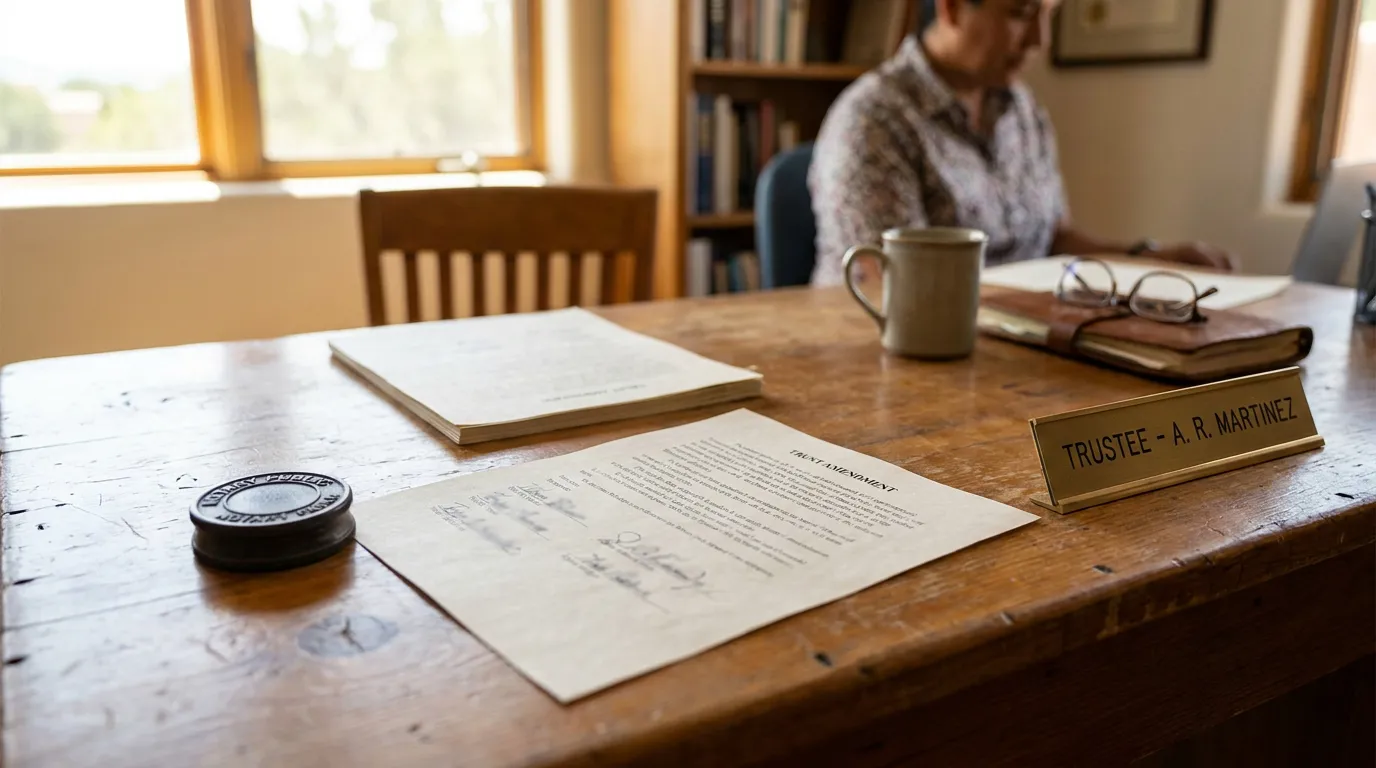
A new mexico nonjudicial settlement agreement allows interested persons to resolve certain trust questions by written agreement rather than by court order. New Mexico enacted the Uniform Trust Code, codified as Chapter 46A of the New Mexico Statutes, which supplies the framework for how trusts may be administered, modified, or ended.
These agreements let families avoid probate court for issues that do not require judicial resolution. A nonjudicial settlement agreement can address matters such as interpreting trust terms, approving a trustee’s actions, or resolving administration questions. To understand the broader statutory backdrop, review the state’s version of the New Mexico Uniform Trust Code and how it fits into your estate plan. The key limitation is that a nonjudicial agreement is valid only to the extent it involves terms that could be properly approved by a court, and it cannot violate a material purpose of the trust or accomplish something the law reserves for a court.
💡 Pro Tip: Before signing any agreement, identify every "interested person" whose consent may be required. Missing a beneficiary can undermine the enforceability of the entire arrangement.
When Consent Alone Can Modify or End a Trust
The clearest route to modify a trust without court in New Mexico is unanimous consent of the settlor and all beneficiaries. Under NMSA 1978, § 46A-4-411(A), "a noncharitable irrevocable trust may be modified or terminated upon consent of the settlor and all beneficiaries, even if the modification or termination is inconsistent with a material purpose of the trust." When the person who created the trust is alive and willing, and every beneficiary agrees, the parties can revise trust terms without asking a judge for permission.
This full-consent path reflects a policy that the people most affected by a trust should be able to reshape it together. You can read the underlying statutory language directly in the state’s codified consent modification statute. This route is limited to noncharitable irrevocable trusts and requires genuine, documented consent from everyone involved. It also assumes each beneficiary has legal capacity to consent, which can complicate matters when minor, unborn, or unascertained beneficiaries are involved and must be represented by others.
What Happens to a Spendthrift Provision
A spendthrift clause does not automatically block a consent-based modification or termination. Many people assume that a spendthrift provision, which protects a beneficiary’s interest from creditors, locks the trust in place. New Mexico law takes a more nuanced view. Under NMSA 1978, § 46A-4-411(C), "a spendthrift provision in the terms of a trust is not presumed to constitute either a material or an immaterial provision of the trust."
Because the statute creates no presumption either way, the effect of a spendthrift clause is fact-dependent. A court or the parties must look at the specific trust and the settlor’s intent rather than treating the clause as a fixed barrier. This is an area where careful analysis matters, and outcomes can vary depending on the language of your particular instrument.
When Court Involvement Becomes Necessary
Court involvement generally becomes necessary when the settlor is unavailable or not all beneficiaries consent. If the settlor has died or cannot participate, beneficiaries may still seek changes, but they typically must go through a judge. Under NMSA 1978, § 46A-4-411(B), a trust "may be terminated upon consent of all of the beneficiaries if the court concludes that continuance of the trust is not necessary to achieve any material purpose," and it may be modified "if the court concludes that modification is not inconsistent with a material purpose."
A partial-consent scenario also opens a supervised path. Under NMSA 1978, § 46A-4-411(E), if not all beneficiaries consent, the modification or termination may be approved by the court if it is satisfied both that the trust could have been modified or terminated had all beneficiaries consented, and that the interests of any nonconsenting beneficiaries are adequately protected. Courts apply these protective conditions carefully, so approval depends on the facts presented.
The following table summarizes the general framework under § 46A-4-411:
| Situation | Court Required? | Governing Subsection |
|---|---|---|
| Settlor and all beneficiaries consent | Generally no | § 46A-4-411(A) |
| All beneficiaries consent, settlor unavailable | Generally yes | § 46A-4-411(B) |
| Not all beneficiaries consent | Yes | § 46A-4-411(E) |
Other Statutory Paths to Change a Trust
Beyond consent, New Mexico’s Uniform Trust Code offers several additional avenues, some of which require court approval. Chapter 46A, Article 4 recognizes that circumstances change and mistakes happen. Common statutory routes include:
- Modification or termination due to unanticipated circumstances or an inability to administer the trust effectively, under NMSA 1978, § 46A-4-412
- Termination of an uneconomic trust that is too small to justify administration costs, under NMSA 1978, § 46A-4-414
- Reformation to correct mistakes in the trust’s terms, under NMSA 1978, § 46A-4-415
- Modification to achieve the settlor’s tax objectives, under NMSA 1978, § 46A-4-416
- Combination or division of trusts, under NMSA 1978, § 46A-4-417
These tools reflect legislative updates that expanded flexibility over time. The current statute incorporates amendments from Laws 2003, ch. 122, § 4-411 and Laws 2007, ch. 128, § 10. Whether any of these paths fits your situation is a fact-specific question best evaluated with counsel.
Why Local Guidance Matters for Trust Changes
Modifying a trust correctly protects everyone who depends on it, and a local attorney adds real accountability. The statutory language may look straightforward, but applying it to a real family with real assets involves judgment about material purpose, consent, and documentation. Thoughtful New Mexico trust modification guidance helps trustees demonstrate that they acted prudently and in line with the trust’s terms.
There is genuine value in an unhurried conversation with someone you can call again later. At Walk-in Wills, our approach centers on building a plan around your actual wishes and executing documents properly. For deeper background, a respected law review analysis of the state’s trust code, written by David M. English, who served as the Reporter for the national Uniform Trust Code, explains how these provisions were adopted and applied.
💡 Pro Tip: Keep signed consents, agreements, and any court orders together with the original trust. Clean records make future administration far smoother.
Frequently Asked Questions
-
Can beneficiaries change a trust if the settlor has died?
Yes, but generally only through the court. Under NMSA 1978, § 46A-4-411(B), beneficiaries may seek termination or modification when the court concludes that continuing the trust is unnecessary to a material purpose or that a modification is not inconsistent with one. Results depend on the facts and the trust’s language.
-
Does a spendthrift clause stop a trust modification in New Mexico?
Not automatically. NMSA 1978, § 46A-4-411(C) states that a spendthrift provision is not presumed to be either a material or immaterial provision. The clause’s effect must be evaluated case by case.
-
What is a nonjudicial settlement agreement used for?
It resolves certain trust matters privately without court approval. Interested persons can address administration questions and trust changes, subject to limits, so long as the agreement involves terms a court could properly approve and does not violate a material purpose or a matter reserved for the court.
-
What if one beneficiary refuses to agree?
A court may still approve the change under certain conditions. Per NMSA 1978, § 46A-4-411(E), a court may approve a modification or termination if it is satisfied both that the trust could have been modified or terminated had all beneficiaries consented and that the interests of nonconsenting beneficiaries are adequately protected.
-
Are all these changes limited to irrevocable trusts?
The consent provisions in § 46A-4-411 apply to noncharitable irrevocable trusts. Other articles of Chapter 46A address different situations, so the right tool depends on your trust type and goals.
Bringing It All Together
Many New Mexico trusts can be modified or terminated without going to court, especially when the settlor and all beneficiaries consent under NMSA 1978, § 46A-4-411(A). When the settlor is unavailable or consent is incomplete, court involvement becomes necessary, and judges apply the statute’s protective conditions carefully. Additional paths under Article 4 address unanticipated circumstances, mistakes, tax goals, and more. Because these outcomes hinge on your trust’s specific language and facts, guidance from a trusted attorney helps you choose the right approach and document it properly.
You do not have to navigate these decisions alone. The team at Walk-in Wills offers face-to-face and online guidance so you have someone in your community to answer questions long after the documents are signed. Call (505) 903-7000 or visit our consultation request page to get started with a plan built around your wishes.