
What Happens to a Car in Arizona When the Owner Passes Away
Key Takeaways: In Arizona, a vehicle does not automatically transfer to family at death, but the process is usually simpler than full probate. If the owner named a beneficiary on the title under A.R.S. § 28-2055(B), the car may pass outside probate entirely. Without a designation, successors may use a small estate affidavit under A.R.S. § 14-3971 when the decedent’s personal property, wherever located and less liens and encumbrances, totals $200,000 or less, at least 30 days have passed since death, and the statute’s other requirements are met. House Bill 2116 increased the threshold from $75,000 effective September 26, 2025. The MVD transfers title once the proper affidavit and fees are presented.
A vehicle in Arizona generally does not transfer to family automatically at death, but the path forward is often simpler than expected. If the owner named a beneficiary on the title, the car may pass outside probate. Without a designation, Arizona law gives heirs a streamlined option: a small estate affidavit that the Motor Vehicle Division honors once the paperwork and fees are presented. For many Chandler families, an arizona vehicle title transfer after death becomes an administrative task rather than a court case, provided the estate qualifies and timing requirements are met.
If you are unsure whether the car requires probate, Walk-in Wills can walk you through it in plain English. Call (480) 470-7000 or schedule your consultation now to find out which route applies before you stand in line at the MVD.
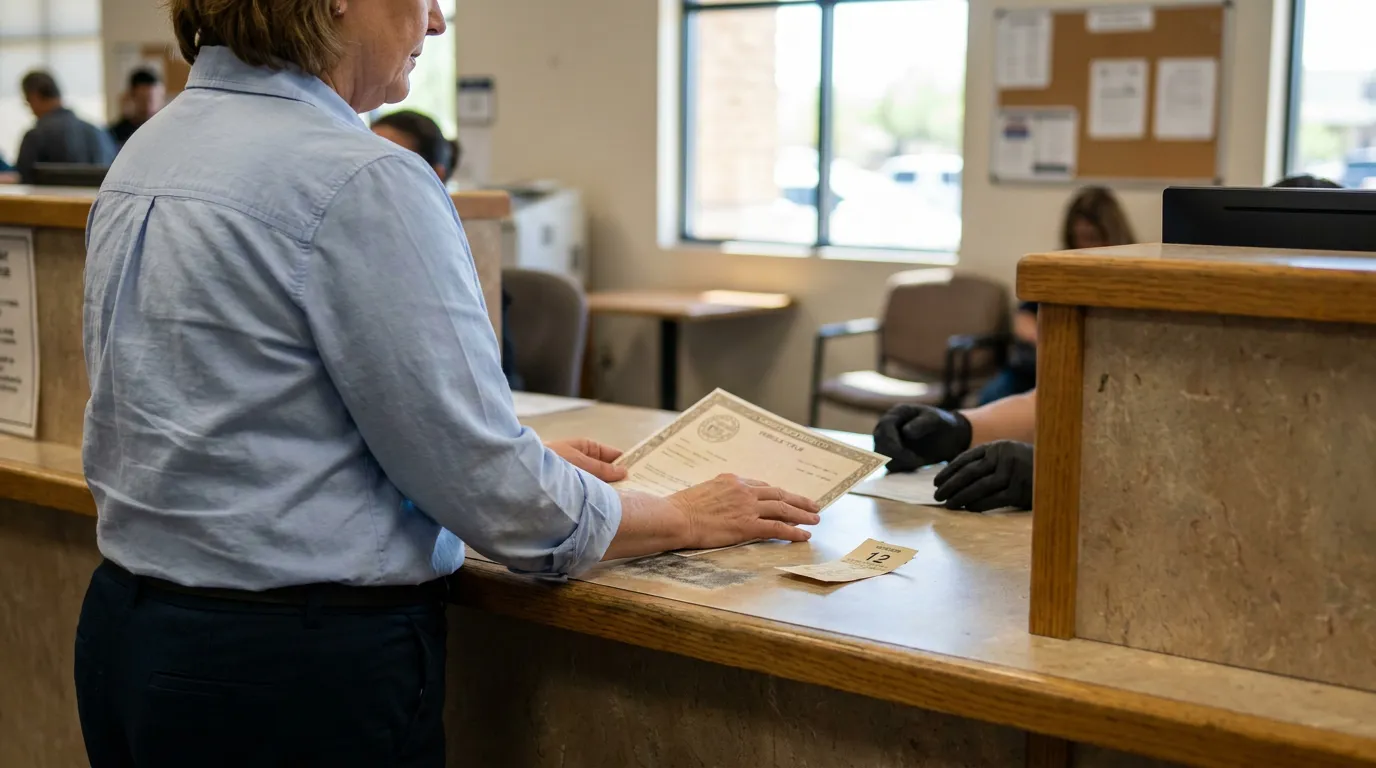
Planning Ahead: The Transfer on Death Designation
Arizona vehicle owners can arrange for a car to pass to a chosen person at death. Under the state’s transfer on death vehicle statute, A.R.S. § 28-2055(B), “At the request of the owner, the certificate of title may contain, by attachment, a transfer on death provision where the owner may designate a beneficiary of the vehicle.” This allows the vehicle to bypass probate when the owner dies, though the beneficiary must complete MVD transfer paperwork and any lien remains attached.
The process involves completing and signing the MVD Beneficiary Designation Form (96-0561). For an electronic title, the form may be submitted alone when transferring ownership; for a paper title, the form must be stapled to the title and surrendered with it when ownership is transferred. After the owner’s death, the beneficiary must complete the applicable MVD title-transfer requirements. This can avoid giving an adult child a present ownership interest in the vehicle during the owner’s lifetime, because the beneficiary designation does not give the beneficiary ownership rights before the owner’s death. The beneficiary has no ownership rights until death, and the owner may revoke or change the designation at any time.
Why the Beneficiary Route Saves Families Time
A beneficiary designation removes the vehicle from the probate calculation. A car titled solely in the deceased person’s name is a probate asset, while a vehicle with a surviving joint owner or effective beneficiary designation falls outside the probate estate. This distinction helps keep the remaining estate under dollar thresholds that permit simplified transfers.
Families who handle this in advance avoid the emotional friction of paperwork during grief. Unlike the small-estate affidavit procedure, the beneficiary route is not subject to the 30-day waiting period in A.R.S. § 14-3971(B), though the beneficiary must still satisfy MVD’s applicable title-transfer requirements. For parallel real estate steps, see our guide on how to change property ownership after death.
💡 Pro Tip: Review your beneficiary designation when your family situation changes. A designation naming someone who has already passed away or who you no longer wish to inherit can quietly undo years of planning.
When There Was No Designation: The Small Estate Affidavit
Arizona law allows heirs to collect personal property, including vehicles, by affidavit instead of opening formal probate. The controlling statute, A.R.S. § 14-3971, confirms vehicles are addressed by this simplified process. If no personal representative is pending or appointed, the affidavit may be used when the value of all personal property in the decedent’s estate, wherever located and less liens and encumbrances, is $200,000 or less as valued as of the date of death. House Bill 2116 raised the threshold from $75,000 effective September 26, 2025.
The affidavit cannot be used until at least 30 days have passed since death. Generally, no application or petition for appointment of a personal representative may be pending and no personal representative may have been appointed in any jurisdiction, although the statute also permits the procedure after a personal representative has been discharged or more than one year has elapsed since a closing statement was filed if the other requirements are met. The affidavit must state that the claiming successor is entitled to the property and that funeral and last-illness expenses have been paid.
What the Statute Requires the MVD to Do
Once the proper affidavit and fees are presented, the transfer is generally treated as a ministerial step. A.R.S. § 14-3971(D) provides that “The motor vehicle division shall transfer title of a motor vehicle from the decedent to the successor or successors on presentation of an affidavit as provided in subsection B of this section and on payment of the necessary fees.”
Arizona law includes protections for those involved in the handoff. Under the discharge provision for affidavit transfers, 14-3972 protects persons transferring personal property pursuant to an affidavit and also protects the MVD when it issues title pursuant to the affidavit, generally to the same extent as if they had dealt with the decedent’s personal representative.
Arizona Vehicle Title Transfer After Death: The Paperwork Involved
The core document at the MVD is the Non-Probate Affidavit, Form 32-6901. ADOT states its purpose plainly: “For obtaining title to the vehicle from a deceased vehicle owner’s estate.” This is generally a short filing rather than a full probate proceeding. ADOT currently requires the completed NonProbate Affidavit and a Title and Registration Application, along with a lien release if applicable; additional documentation may be required depending on the vehicle and circumstances.
Download arizona title transfer forms directly from ADOT rather than third-party sites that may host outdated versions.
|
Situation |
Typical Path |
Key Authority |
|---|---|---|
|
Beneficiary named on title |
Beneficiary completes applicable MVD title-transfer requirements; no probate |
A.R.S. § 28-2055(B) |
|
No designation, personal property $200,000 or less (net of liens) |
Small estate affidavit at MVD after 30 days |
A.R.S. § 14-3971 |
|
Court-appointed personal representative exists |
Transfer handled through estate administration |
A.R.S. § 14-3971 |
|
Real property also involved |
Separate affidavit, 6-month wait, $300,000 equity cap |
A.R.S. § 14-3971 |
Common Snags Chandler Families Run Into
Most delays come from small details rather than legal disputes. In our experience helping families with a chandler probate vehicle question, the recurring issues include:
-
Filing before the 30-day waiting period has run
-
Miscounting which assets belong in the $200,000 personal property total
-
Missing or improper notarization on the affidavit
-
Not bringing the additional title or lien documents required for the particular vehicle
-
An outstanding lien or loan balance still attached to the vehicle
Each of these is fixable, but often only after a wasted trip. A brief conversation before you file can prevent the second and third visit. Our team also handles the broader estate distribution process when the vehicle is one piece of a larger picture.
How Vehicles Fit Into the Rest of the Estate
The car is rarely the only asset, and the decisions interact. Arizona currently has no state estate or inheritance tax, though federal estate tax rules can apply to larger estates. For real property, a separate Affidavit for Transfer of Title to Real Property may apply, with different conditions: a six-month wait after death and equity value of $300,000 or less.
A personal representative is a fiduciary who must administer the estate in accordance with the will and Arizona law, including properly accounting for estate assets and addressing valid creditor claims rather than favoring one beneficiary or heir without legal authority.
Working With a Local Attorney You Can Actually Reach
The value of a local chandler estate planning attorney often shows up when a question comes up weeks later. Walk-in Wills serves families in Chandler as well as Mesa, Gilbert, and Queen Creek, with a fully online option available throughout Arizona for clients who are mobility-limited, live rurally, or are coordinating a parent’s plan from out of state. We offer flat-fee transparent pricing, roughly one-week document turnaround, on-site notaries and witnesses, and same-day, mobile, and Saturday-by-appointment services including home and hospital visits.
An unhurried, plain-English conversation tends to surface things a form never will: a second vehicle nobody mentioned, a loan still in the decedent’s name, or a beneficiary designation that no longer reflects anyone’s wishes. New estate-planning matters include a one-hour consultation at no charge.
Frequently Asked Questions
1. How long do we have to wait before using the small estate affidavit?
At least 30 days must pass after the date of death under A.R.S. § 14-3971. Generally, no application or petition for appointment of a personal representative may be pending and no personal representative may have been appointed, although the statute also allows the affidavit procedure after a personal representative has been discharged or more than one year has elapsed since a closing statement was filed.
2. Does a vehicle with a beneficiary designation count toward the $200,000 limit?
Generally, no. Vehicles that pass by effective beneficiary designation or to a surviving joint owner fall outside the probate estate and may be excluded from that calculation.
3. What if the car still has a loan on it?
An existing lien does not disappear when the owner dies. ADOT requires a lien release or a letter of permission from the lienholder to transfer ownership through the Non-Probate Affidavit process. Liens and encumbrances are also deducted when determining whether the decedent’s personal property falls within the $200,000 affidavit threshold.
4. Can we handle a mvd title transfer deceased matter entirely online?
The Non-Probate Affidavit process is not necessarily limited to an in-person MVD visit. ADOT allows qualifying non-probate title-transfer documents to be submitted by mail in certain circumstances, and MVD or Authorized Third Party offices can also handle the process.
5. Is a will enough to transfer the car by itself?
Generally not on its own. A will directs who inherits, but the vehicle requires either a beneficiary designation, an affidavit transfer, or estate administration for the arizona motor vehicle division estate paperwork to be completed.
Moving Forward With Confidence
Transferring car ownership after death in Arizona often comes down to two questions: did the owner name a beneficiary, and does the estate qualify for the affidavit process? When a transfer on death provision exists under A.R.S. § 28-2055(B), the vehicle may bypass probate. When it does not, A.R.S. §§ 14-3971 and 14-3972 may give heirs a short, protected affidavit path that the MVD is directed to honor. Vehicle inheritance in Arizona is often manageable, but the details, waiting periods, and dollar thresholds matter.
Whether you are planning ahead so your family never has to file an affidavit, or you are holding a deceased owner vehicle Arizona title question right now, Walk-in Wills is here to help. Call (480) 470-7000 or reach out to our team today to get clear answers from an attorney who will be there when your next question comes up.
Disclaimer: This content is for informational purposes only and is not legal advice. Every case is unique, and results may vary. Consult an attorney about your specific circumstances.